
No products in the cart.
Building a Bullion Inventory You Can Actually Manage


Buying physical bullion creates something that a digital account does not: a collection of individual objects.
At first, managing those objects can feel simple. A buyer may own one gold bar, one coin or a few silver bars. Each product is familiar, and remembering what was purchased requires little effort.
That changes as a holding grows.
Several purchases can introduce different metals, weights, refineries, product formats and purchase dates. What began as a small collection can gradually become difficult to remember accurately without a consistent system.
A bullion inventory solves that problem.
It does not need to be complicated. Its purpose is simply to create a reliable record of what you own while making the physical collection easier to organize, review and eventually transfer or sell.
Why Bullion Inventory Matters
Physical ownership gives the buyer direct control over the asset, but direct ownership also creates responsibility.
A digital investment platform automatically records transactions and balances. Physical bullion does not automatically create the same centralized history.
The owner needs to know what is actually present.
A useful inventory can help answer questions such as:
- How many gold bars do I own?
- What weights do I currently hold?
- Which refineries are represented?
- How much silver is stored?
- Which products were purchased most recently?
- Which pieces have individual serial information?
- Where are the purchase documents?
These questions become more important as the collection expands.
Start With the Product Name
Every inventory entry should begin with a clear product description.
Avoid vague labels such as “gold bar” or “silver.”
Instead, record enough information to identify the product without physically retrieving it.
For example:
20 Gram Valcambi Swiss Gold Bar
That entry immediately communicates the weight, refinery, metal and product format.
RM Bullion currently lists its 20 Gram Valcambi Swiss Gold Bar at 999.9 fineness, making these specifications straightforward to record together. RM Bullion
A consistent naming system prevents confusion later.
Record the Metal Separately
Even if the product name already includes the metal, creating a separate metal field can make an inventory easier to review.
A simple classification might use:
- Gold
- Silver
This allows the owner to quickly understand how the physical holding is divided.
It also becomes useful when calculating total weights separately because gold and silver should not simply be combined into one meaningless total.
Weight Needs Its Own Field
Weight is one of the most important bullion specifications.
Record both the number and the unit.
Examples include:
- 5 g
- 20 g
- 50 g
- 1 oz
- 250 g
- 1 kg
Do not record only “20” or “1.”
The measurement unit matters.
Bullion uses both metric measurements and troy ounces, so an inventory needs enough information to avoid ambiguity.
Record Fineness
Fineness describes precious-metal purity.
A Valcambi gold bar may be listed at 999.9 fineness, while a Metalor silver product may be listed at 999. RM Bullion
Recording fineness creates a more complete product record.
A basic entry could therefore include:
- Product: 20 Gram Valcambi Swiss Gold Bar
- Metal: Gold
- Weight: 20 g
- Fineness: 999.9
- Refinery: Valcambi
The owner can understand the essential product without opening storage.
Keep Refinery Information Consistent
Avoid entering the same refinery under several slightly different names.
For example, if you begin using “Valcambi,” continue using that convention rather than alternating between “Valcambi,” “Valcambi Suisse” and “Valcambi SA” in different rows.
Consistency makes sorting easier.
RM Bullion’s current product selection includes recognized Swiss refinery products from Valcambi and Metalor. RM Bullion
A standardized inventory can group products by refinery whenever needed.
Include Quantity
If several identical bars were purchased, there are two ways to record them.
You can create one entry and add a quantity field, or record each physical piece separately.
The appropriate method depends on the products.
For identical bars without individual information, a quantity field can be efficient.
For products with unique serial information, individual entries may be clearer.
Serial Information Deserves Its Own Record
When a bullion product includes an individual serial number or identifying reference, record it accurately.
Do not rely on memory.
Serial information can help distinguish one bar from another, particularly when several products have the same weight and refinery.
This can also support future documentation if the collection is transferred or reorganized.
Add the Purchase Date
A purchase date gives the inventory a timeline.
Over several years, this becomes useful for understanding how the holding developed.
The owner can see whether the collection was accumulated gradually, which denominations were purchased first and how buying preferences changed.
Use one date format consistently.
For example:
2026-09-29
A consistent format also makes digital sorting easier.
Keep Purchase Documents Connected
An inventory is most useful when it connects to supporting records.
The owner may keep:
- Invoice
- Order confirmation
- Payment record
- Collection confirmation
- Delivery documentation
- Product photographs
These documents do not necessarily need to sit physically beside the bullion.
They simply need to be organized so they can be matched to the correct inventory entry.
Avoid Recording Sensitive Storage Details in an Exposed File
Documentation is useful, but discretion matters.
An inventory stored on an everyday computer or cloud account does not necessarily need to contain exact information about where bullion is physically stored.
There is a difference between writing:
Secure storage
and recording detailed access instructions in the same file that lists the entire holding.
Keep inventory information useful without creating unnecessary security exposure.
Separate Inventory From Access Information
If another trusted person eventually needs access to the collection, consider keeping access instructions separately from the general bullion inventory.
This reduces the amount of sensitive information concentrated in one document.
The inventory describes the assets.
A separate secure record can explain access arrangements when appropriate.
Organize the Physical Collection in the Same Logic
A spreadsheet is most useful when the physical collection follows a similar structure.
For example, products might be grouped by:
- Metal
- Refinery
- Weight
- Product format
Gold bars can occupy one area.
Gold coins can remain separate.
Silver bars can be organized by weight.
The exact structure matters less than consistency.
Avoid Constant Reorganization
A collection does not need to be rearranged every time another product is purchased.
Repeated handling creates unnecessary work and can expose bullion surfaces or packaging to damage.
Instead, create enough space in the storage system to accommodate future purchases.
An organized system should reduce handling rather than create more of it.
Gold and Silver Need Different Space Planning
Gold concentrates substantial value into compact physical dimensions.
Silver requires more space for the same monetary allocation.
This difference becomes obvious when comparing products such as a compact gold bar with a 250 Gram Metalor Swiss Silver Bar or one-kilogram silver format. RM Bullion lists the 250g Metalor bar at 999 fineness and dimensions of 40 x 87 mm. RM Bullion
A bullion inventory should therefore track both quantity and total physical weight.
Calculate Total Gold Weight
Once every gold product has a recorded weight, the owner can calculate the total amount of gold represented by the collection.
If several units use troy ounces and others use grams, convert them to a common unit before adding them.
One troy ounce is approximately 31.1035 grams.
A collection containing:
- 20 g
- 50 g
- 1 troy ounce
would therefore represent approximately 101.1035 grams before considering any additional pieces.
The calculation makes the holding easier to understand as a whole.
Calculate Silver Separately
Do not add gold and silver weights together as though they represent one useful figure.
A kilogram of silver and a kilogram of gold may have identical physical weight, but they represent very different metals and market values.
Track totals separately.
For example:
- Total gold weight
- Total silver weight
- Number of gold bars
- Number of gold coins
- Number of silver bars
This creates a clearer overview.
Product Count Is Different From Metal Weight
Ten small bars may represent less total metal than one large bar.
For that reason, an inventory should show both product count and total weight.
Product count helps with physical verification.
Weight helps explain the actual quantity of precious metal.
Both numbers answer different questions.
Review the Inventory Periodically
A bullion inventory does not need constant attention.
Reviewing it periodically can be enough.
A useful review might check:
- Does the digital record match the physical products?
- Are recent purchases included?
- Are supporting documents organized?
- Are quantities correct?
- Are serial references recorded where relevant?
- Is the storage arrangement still practical?
The objective is verification, not unnecessary handling.
Update the Record Immediately After a Purchase
The easiest time to record a bullion purchase is when it is new.
Waiting several months creates avoidable uncertainty.
Once the product has been received or collected, record its specifications and connect the supporting documentation.
Then place it into the established storage system.
This turns organization into part of the buying process rather than a separate future project.
An Inventory Helps With Future Decisions
A clear inventory does more than describe the past.
It can also inform the next purchase.
Suppose the record shows that the buyer already owns many small gold bars but no larger denomination.
That may influence the next decision.
Another owner may discover that silver has become physically difficult to store and decide to focus future purchases differently.
The inventory makes these patterns visible.
It Also Helps With Partial Selling
If an owner eventually wants to sell only part of a holding, an inventory can make selection easier.
Instead of opening storage and deciding from memory, the owner can review available denominations first.
Several smaller bars may provide different options from one large bar.
The inventory does not determine what should be sold.
It simply makes the available choices clearer.
Think About Long-Term Transfer
Physical bullion may eventually be passed to another person.
A clear record makes that process easier.
Without documentation, a recipient may receive several products without immediately knowing their weights, refiners or purchase history.
A structured inventory gives the collection context.
This can be particularly useful for long-term family holdings.
Keep the System Simple Enough to Maintain
An inventory that requires twenty fields for every product may eventually stop being updated.
The best system is one the owner can realistically maintain.
A practical record might include:
- Product
- Metal
- Weight
- Fineness
- Refinery or mint
- Quantity
- Serial information where applicable
- Purchase date
- Document reference
Additional information can be added when it serves a real purpose.
Organization Supports Physical Ownership
Bullion ownership is deliberately tangible.
The buyer owns individual bars and coins rather than an abstract balance.
That physical quality is part of the appeal, but it also means organization matters.
A manageable inventory gives structure to the holding without making ownership unnecessarily complicated.
Know what you own.
Know how much you own.
Keep the products organized.
Keep the supporting records connected.
As the collection grows, those simple habits become increasingly valuable.
Frequently Asked Questions
Do I need an inventory for a small bullion collection?
Even a simple record can be useful because it creates a consistent system before the collection becomes larger.
What information should a bullion inventory contain?
Useful fields include product name, metal, weight, fineness, refinery or mint, quantity, serial information where applicable, purchase date and document reference.
Should gold and silver weights be combined?
No. Track total gold and total silver separately because they are different metals with different market values.
Should I record bullion serial numbers?
Yes, when a product includes individual serial information, recording it can help distinguish and document that specific piece.
How often should I review my bullion inventory?
Periodic reviews and updates after each new purchase are generally enough to keep the record accurate.
Build Your Bullion Holding With Clarity
Explore gold bars, gold coins, and silver bars across practical weights and recognized Swiss refineries.
Related Articles

Small Gold Bars Make Gold Buying More Flexible
Small gold bars have become a practical choice for buyers who want to own physical gold...
Read More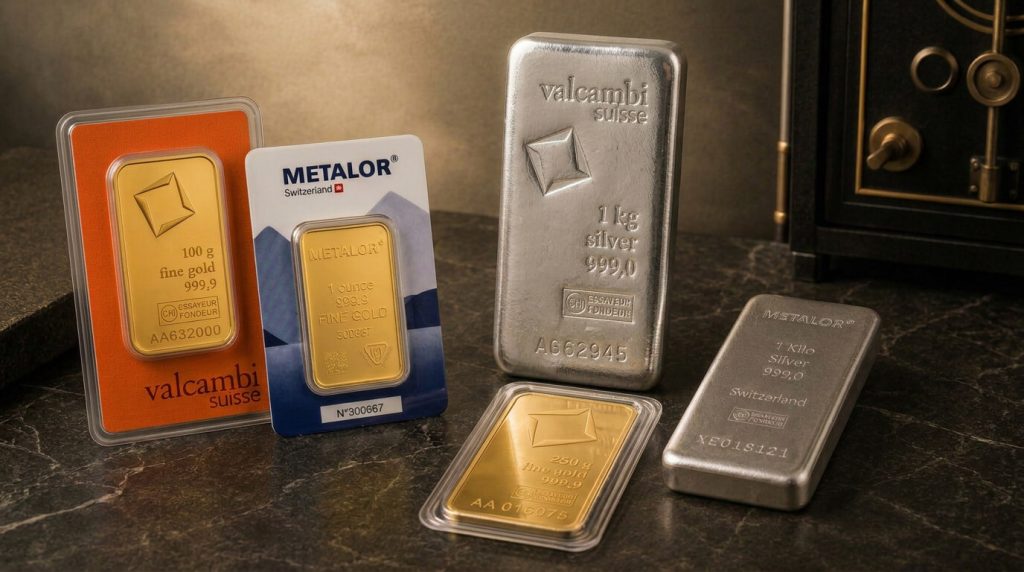
Why Bullion Packaging and Handling Matter
Buying physical bullion is only the beginning of ownership. Once a gold bar, gold coin, or...
Read More
Recognized Refineries Add Confidence to Precious Metal Buying
When buying physical precious metals, the metal itself is only part of the decision. Buyers also...
Read More